
Developers
Contribute to ai-memory
101 people have landed code so far. This page gets you from an idea to the right issue, the right crate and a pull request that passes review the first time.
An active project, in numbers
Counts come from the GitHub API when this site is built.
Top contributors
akitaonrails
djalmajr
samirhvbr
lucasliet
wblech
rthiago
matheus-rodrigues00
lhzapata
gabrielscharb
pablowinck
aguirreSL
evanmaranzano
kevin9327
gb
mrpaiva
rafaelkenedy
lihuiyang1024
rodrigopalhares
felipe-NR
abhisheksharma2411
Cardosaum
vitorvilas
mobnix
Murillofilho86
viniciusdsandrade
atirna
pedrofjr
enrell
zanlucathiago
davividal
alanhoff
alvadorn
milesibastos
klebervirgilio
iagogfe
dk96-creator
juniorgaudencio00-code
PedroPCardoso
marcelomogami
lucazz
jpramos123
cateim
Gaalbu
bcosta19
BobDylans
victorcesc
Wprosdocimo
XiaoHuo888-hue
adrianogomes-NE
azevedo-luis
cristianodewes
luisfnicolau
omartelo
wslcb
holocaster
rpaggi
murilojrpereiras
LuizFernando991
jaysonsantos
Pick your way in
Each of these goes to the exact page on GitHub.
Report a bug
The template asks for your version, OS, agent, transport and the relevant server log lines.
Open a bug reportPropose a feature
Proposals are issues; the repository has no discussions board. The template asks what problem it solves and whether it would break existing installs.
Open a feature requestFind a first issue
The good first issue label marks work that suits a newcomer. Help wanted marks the rest.
Browse good first issuesAdd or fix a harness
Managed harness support has a written protocol: prove the native session contract, read stores read-only, deliver context before acknowledging it, and ship the required tests.
Read the harness protocolImprove the docs
Guides live in docs/ as markdown. A doc fix is a normal pull request and skips the changelog when nothing user-facing changes.
Browse docs/Build around it
Importers, richer UIs and chat front ends belong in companion projects that use the public HTTP and MCP surfaces.
Read the companion rules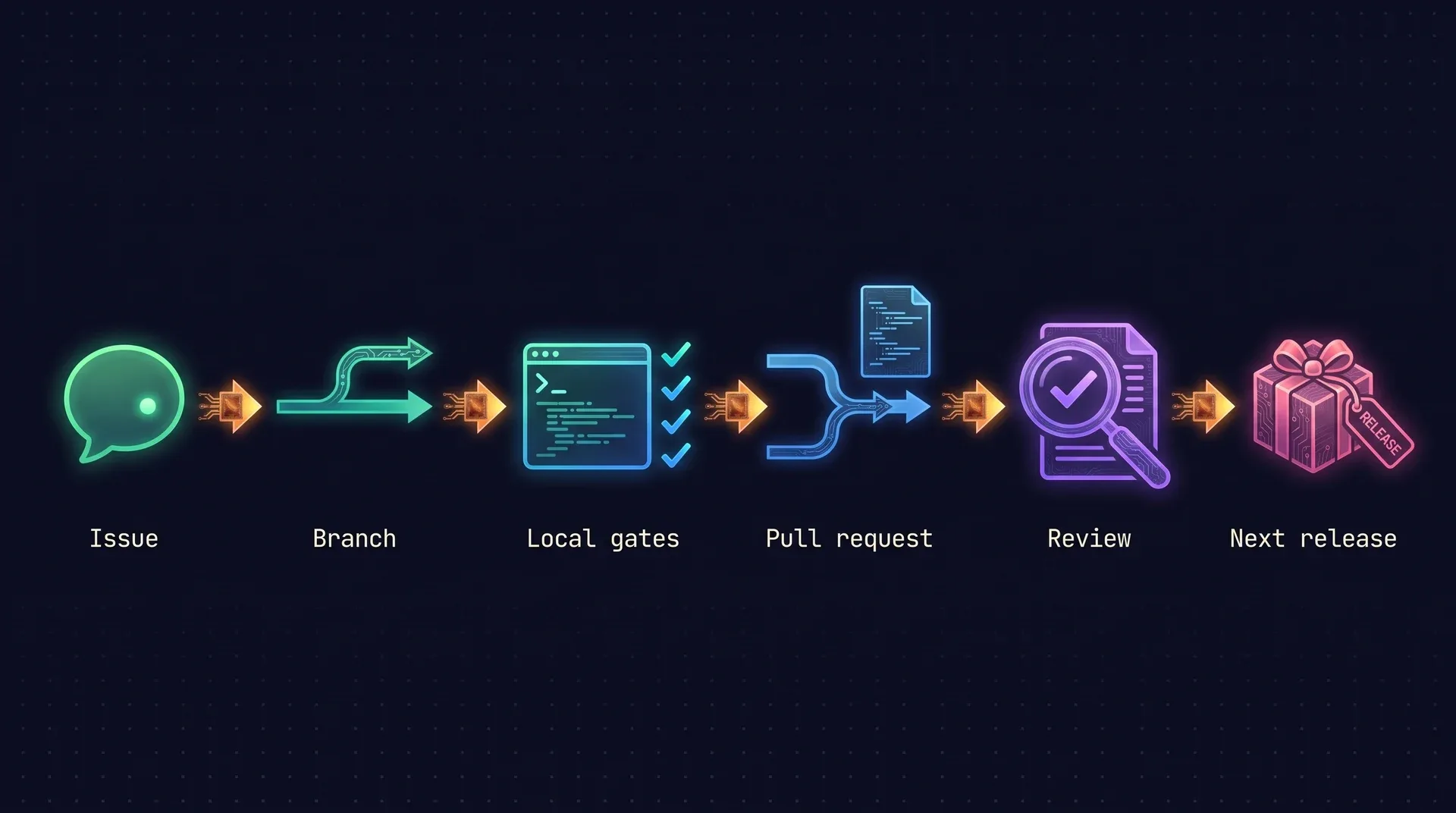
Get it building
The build is self-contained. None of these commands needs an environment variable.
Clone and build
Rust 1.95 is required and pinned in
rust-toolchain.toml, with rustfmt and clippy, so rustup installs the right toolchain on first build. SQLite is bundled and libgit2 is vendored. You need a standard C toolchain and nothing else.dev setup git clone https://github.com/akitaonrails/ai-memory cd ai-memory cargo build --workspace cargo test --workspace --all-targetsUse the everyday loop
cargo tneeds nextest:cargo install cargo-nextest --locked. It skips modules namedsloworstress, which the pre-push hook and CI still run.while you work cargo t # all but the slow tier, ~20s warm cargo t -p ai-memory-store # one crate: builds only its test binaries cargo t -E 'test(/purge/)' # one topic (builds everything, runs a subset)Install the pre-push hook
Once per clone. It only touches its own block in
.git/hooks/pre-push. On a work-in-progress branch,git push --no-verifyskips it.once per clone scripts/install-git-hooks.shPass the gates before you push
CI enforces all five. Without nextest,
cargo test --workspace --all-targetsis the equivalent ofcargo tf. If the last one is missing:cargo install cargo-deny cargo-audit.required gates cargo fmt --all -- --check git diff --check cargo clippy --workspace --all-targets -- -D warnings cargo tf # every test (alias: cargo nextest run -P full) cargo deny check # dependency policyCheck who your commits say you are
Use an email verified on your GitHub account or its noreply address. History on main is never rewritten to fix attribution.
commit attribution git log --format='%h %an <%ae>' "$(git merge-base HEAD origin/main)"..HEAD
Ground rules and the acceptance bar
AGENTS.md is the canonical rules file for people and for coding agents. CONTRIBUTING.md condenses it to this.
How work is expected to land
The changelog is a merge gate
Every user-facing change adds an entry under [Unreleased] in the same pull request. Reviewers treat a missing entry as blocking. Refactors and test-only changes are exempt.
Tests before “done”
Work counts as done once it has tests, above all parsers, ID derivation and the retention math.
No dead code, no half-built features
Stubs are documented in the module comment with the milestone that will finish them.
Stay inside the change
Do not refactor code the current milestone does not need.
Comments explain why
A comment that restates the line above it gets removed.
Invariants a pull request cannot break
- All SQLite writes go through the single writer actor,
WriterHandle. - Config is read once at startup. No
std::env::varoutsideConfig::load. - File writes are atomic: tmp, rename, fsync. Never in place.
- Every wiki page is namespaced by
(workspace_id, project_id). - The CLI is a thin HTTP client. It never opens the SQLite file or the wiki directory.
The full list, with the bug each one prevents, is in AGENTS.md
A map of the codebase
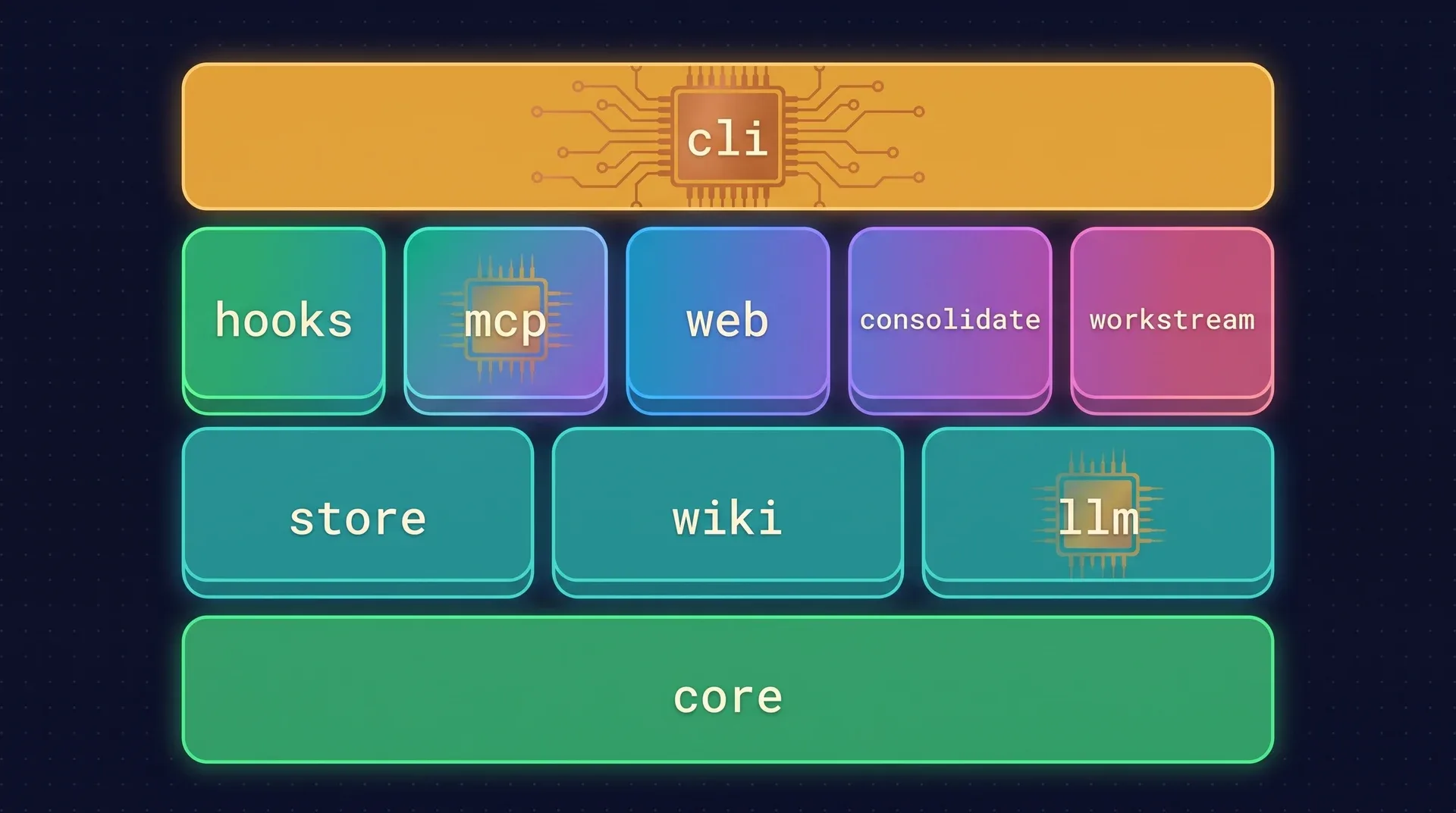
Ten crates ship in the binary. Each has one responsibility and a typed API, and there are no circular dependencies.
| Crate | What lives there |
|---|---|
ai-memory-core | Domain types, errors and ids. No IO. |
ai-memory-store | SQLite, the writer actor, the reader pool and the decay math. |
ai-memory-wiki | Atomic markdown writes, the file watcher and git. |
ai-memory-mcp | The MCP transport, the tool router and the admin routes. |
ai-memory-hooks | Hook payload schemas, the sanitizer and the /hook endpoint. |
ai-memory-llm | The provider auth boundary and the LLM and embedder traits. |
ai-memory-consolidate | Ingest, lint, sweep and the auto-improve pipeline. |
ai-memory-web | The read-only /web browser and the /api/v1 JSON routes. |
ai-memory-workstream | Read-only native transcript readers and the launch adapters behind ai-memory run. |
ai-memory-cli | The ai-memory binary and its thin HTTP subcommands. |
Outside crates/
| Directory | What lives there |
|---|---|
companions/ | ai-memory-importer, a standalone package outside the root workspace. Build it with --manifest-path. |
hooks/ | Lifecycle hook bundles, one folder per agent, shell and native. |
evals/ | The benchmark harness. A workspace member that is never shipped. |
docs/ | Architecture, design decisions, install, deploy and usage guides. |
tests/ | End-to-end smoke tests, hook shell tests and fixtures. |
Integration tests live in tests/suite/ inside each crate. Helpers shared between crates go in crates/ai-memory-test-support, which is never shipped.
How pull requests get reviewed
Reviews follow the pull request template, so filling it in honestly is most of the work.
The template is the checklist
It asks what changed, why, a test plan with the gates ticked, commit attribution, release impact and the changelog entry.
Say what kind of release it is
Tick patch, minor or major. A fix filed under “Added” can bump the wrong version, so put the changelog entry under the right heading.
Breaking changes wait for a major
Call them out in the description. They get the breaking-change label and are scheduled, so they do not hold up patch and minor releases.
CI is fast per merge
A merge gates on the fast Linux jobs. The macOS and Windows legs run on a label, nightly or by hand, and always before a release.
Fixes ship first
A bug fix goes out in the next patch release and is not held for feature work. A new harness or provider ships in the next minor.
A harness pull request runs this shorter gate, records the CLI version it was tested against, and includes a manual pass against the real harness.
cargo fmt --check
git diff --check
cargo test --workspace
cargo clippy --workspace --all-targets -- -D warnings
Try it before you change it.
Run it on your own projects for a day. The bug you find is your first issue.